
The chain rule is one of the most important principles in calculus. It is used to find the derivative of composite functions—functions that are made by combining two or more functions together. Without the chain rule, differentiating many real-world mathematical models would be extremely difficult.
What Is the Chain Rule?
The chain rule is a formula that helps calculate the derivative of a composite function. A composite function is when one function is inside another, such as:
- ( f(g(x)) )
- ( \sin(x^2) )
- ( e^{3x+1} )
In simple terms, the chain rule says:
Differentiate the outer function first, then multiply by the derivative of the inner function.
Chain Rule Formula
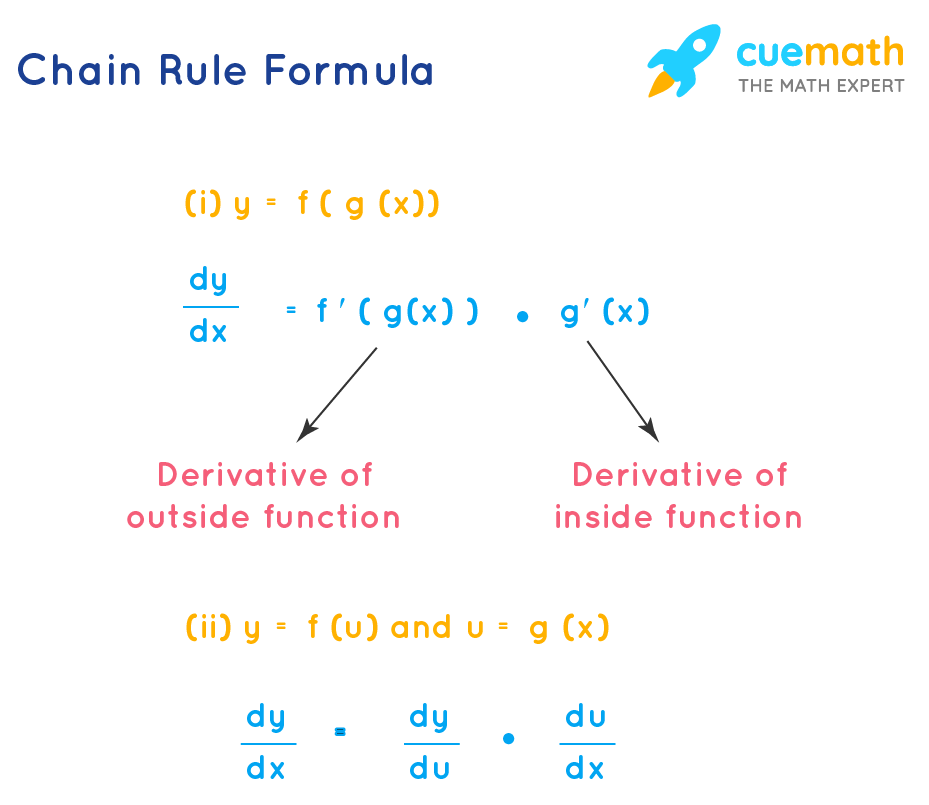
If a function is written as:
- ( y = f(g(x)) )
Then the chain rule is:
[
\frac{dy}{dx} = f'(g(x)) \cdot g'(x)
]
This means:
- Differentiate the outer function while keeping the inner function unchanged.
- Multiply by the derivative of the inner function.
Simple Example of the Chain Rule
Let’s say:
- ( y = (x^2 + 3)^5 )
Step 1: Identify functions
- Outer function: ( (\cdot)^5 )
- Inner function: ( x^2 + 3 )
Step 2: Differentiate outer function
- ( 5(x^2 + 3)^4 )
Step 3: Multiply by inner derivative
- Derivative of ( x^2 + 3 ) is ( 2x )
Final Answer:
[
\frac{dy}{dx} = 5(x^2 + 3)^4 \cdot 2x
]
[
= 10x(x^2 + 3)^4
]
Why Is the Chain Rule Important?
The chain rule is widely used in mathematics, science, engineering, and economics. It helps solve complex problems involving changing variables.
Key Applications:
- Physics (motion, velocity, acceleration)
- Engineering systems
- Machine learning algorithms
- Economic modeling
- Biological growth models
Real-Life Understanding of the Chain Rule
Think of a machine with multiple steps:
- Input goes into a system
- The system processes it
- Another system depends on the first output
The chain rule helps us measure how changes in the input affect the final output through multiple stages.
Common Mistakes When Using the Chain Rule
Students often make mistakes such as:
- Forgetting to multiply by the inner derivative
- Mixing up inner and outer functions
- Incorrect simplification
Careful step-by-step solving helps avoid these errors.
Practice Example
Find the derivative of:
- ( y = \sin(3x^2) )
Solution:
- Outer function: ( \sin(\cdot) )
- Inner function: ( 3x^2 )
Derivative:
[
\frac{dy}{dx} = \cos(3x^2) \cdot 6x
]
Final Thoughts
The chain rule is a core tool in calculus that unlocks the ability to differentiate complex functions. Once mastered, it becomes a powerful technique for solving advanced mathematical problems across many fields of study.